Lead Quality
Too many unqualified inquiries create noise and drain commercial capacity.
Connect acquisition, visibility, conversion, content and follow-up.
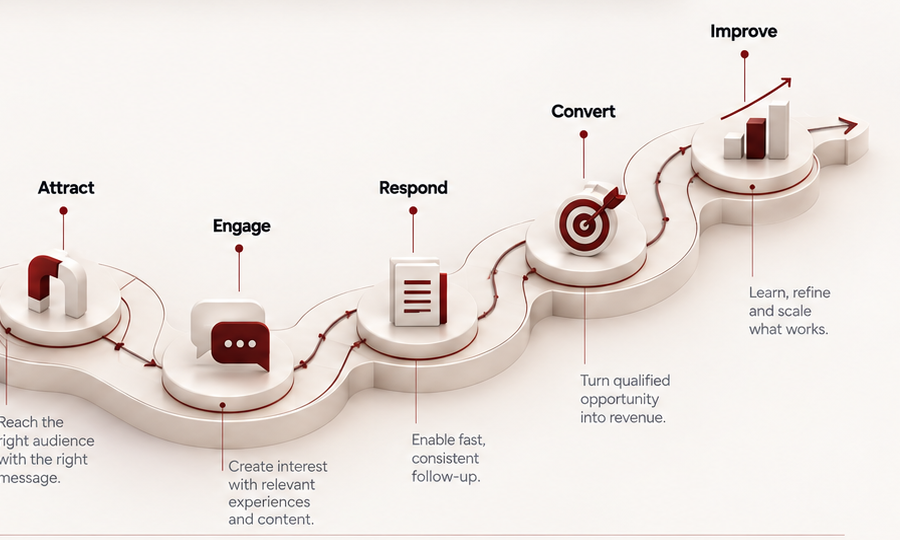
We examine the journey as a connected system, from first discovery to the way an inquiry becomes a customer relationship.
Channel strategy, campaign management, account audits, tracking and creative iteration.
Explore Paid AdvertisingTechnical and content-led search visibility, local discovery and AI-search readiness.
Explore SEO & AI SearchCommercial storytelling, short-form and long-form editing, repurposing and production workflows.
Explore Content & VideoWeb experiences, landing pages, storefronts, CRO and measurable conversion journeys.
Explore Websites & FunnelsPipeline setup, appointment workflows, retention communications and customer response systems.
Are the people arriving relevant?
What happens after the first inquiry?
Which steps create unnecessary friction?
What makes the relationship valuable over time?
Commercial performance cannot be understood from traffic, inquiries or sales reports alone. Those numbers are produced by a sequence of decisions: where attention is purchased or earned, how the offer is explained, what happens after contact, how an opportunity is qualified and whether the business can deliver what was promised. Weakness in one stage can make investment in another look ineffective.
An effective commercial review connects marketing economics to operating capacity. It asks whether the right customers are arriving, whether conversion definitions reflect real value, and whether teams have the information and ownership to respond. Advertising, search, content, web experience and CRM are separate disciplines, but the buyer experiences one journey.
Is the audience likely to need, afford and value the offer?
Relevant inquiries, fit criteria and source context.Can prospective customers understand the offer and act without confusion?
Content comprehension, page paths and common objections.Who owns a new opportunity and what happens next?
Assignment, response times and stage definitions.What value remains after acquisition and fulfillment costs?
Qualified pipeline, revenue quality and cost assumptions.Imagine a regional services business that improves online visibility but receives more inquiries than its branches can answer promptly. The marketing report shows progress, while managers experience frustration and customers wait. Buying more media would be a poor response unless the bottleneck is understood.
A cross-functional plan could establish common lead definitions, route inquiries based on capacity, simplify the booking path and adjust campaigns to what the locations can deliver. The first milestone might be response reliability, not campaign volume. This example illustrates the decision process and is not an Avermont client case.
Before funding another growth initiative, identify the most consequential point where qualified opportunity is delayed, misunderstood or lost.
Tell us where demand, follow-through or conversion seems to be losing momentum.
Discuss an Engagement